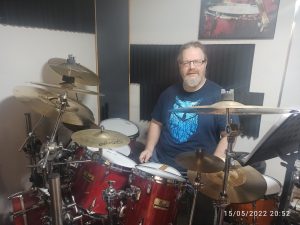
Have you heard that thing people do, you know the: Who is the best drummer, who is the best guitarist, who is the best… well, you get the idea. It’s something that powers polls all over the internet, and of course, it can be about anything, but I’d argue you can’t apply this to music or any art form. As a drummer, I have been asked so many times who is the best drummer, and my answer has always been the same: there isn’t one, I just have my favourites.
Music is not a Sport
The internet is filled with ‘who is the best’ polls; we seem to be obsessed with finding a way to measure skill and artistry in some sort of way, and it doesn’t work for art. Art isn’t a sport; it’s subjective and can’t be measured in the same way as you can, for example, say who is the fastest runner or the most powerful weightlifter. Sport is its own wonderful category and is at its best and most human when it doesn’t become a business, much like many things, but that’s probably a different article.
Art is subjective; no one looking at a Van Gogh painting is counting the number of brush strokes or colour used to rate its success. Our love of ‘The Starry Night’ by Van Gogh is subjective; it either moves you or it doesn’t, to varying degrees, and that is how art is measured, by the individual. It’s the same with writing. If we measure an author’s greatness by the number of books they sell or how big the book is, we are missing the point of how they connected with their readers, how they told the story, and how they made you feel unique reading their work, again, the subjectivity. If we go on sales alone, then ’50 shades of grey’ is a better book than ‘The Grapes of Wrath’ and Bridget Jones’s Diary, which I don’t think it is, in my humble, subjective opinion.
We seem to want to be able to measure music scientifically to make it competitive, like sport, how fast someone can play, how many beats they can play, how complex the patterns are, etc. and sure, we can measure those things, but it has little to do with who is the best drummer or, for that matter, who is the best at anything, if being best is even a thing when we talk about an art form.
The lists on the internet are just clickbait, I think they drive an unhealthy obsessive need to rate everything, and this, in turn, puts additional pressure on new artists, who might already be struggling with their validity. Just because someone doesn’t like your art doesn’t make it bad, and perfection is not a goal; it’s a consequence at best.
Music is not a Science, it’s a science
I recently read the statement, ‘Theory flows from music, music doesn’t flow from theory,’ and I think this applies to all art. Art can exist even when the artist doesn’t have a clue what the theory is. However, when we want to talk about art in a ‘professional way’, we use conventions and labels to describe it. And this is where music is different to most other art forms, it has a dedicated language used to capture and record it, which is where the science comes in.
When you read a music manuscript, every note is recorded in dots and squiggles, which allows any musician who can read music to play the tune or song as it was originally written. It is a form of mathematical notation where each symbol denotes a rest or note being played or not played by the musician at a specific time for a specific time. So it can be recorded, even measured, like science, and if that’s the case, we can rate that performance in a sports-like way and work out who’s best, right? No, unless your goal is an unemotional rendition of music played by robots (or androids like Data, Trekkie moment) with no human interaction.
When music is played by a collection of musicians, their character and interpretation make the performance unique. Nuances of how a note on the manuscript is played, slightly emphasised more, maybe a touch behind the beat, the angle the bow hits the string, the sound of one drum stick compared to another, the syncopation. These all add ‘character’ to each performance, which is rarely repeated, and this is why, using classical music as an example, as it’s often played from manuscript, the performance of a string quartet with Pablo Casals on cello would ‘feel’ different to the same piece of music played by the same string quartet but now with Jacqueline du Pré playing cello. Neither performance is better, just different; you pick the one that moves you the most.
When you move away from classical music and look at Blues, Jazz and forms of rock, the differences and individual interpretation become even more diverse and character-based. This is why asking ‘who’s best’ is the wrong question, and should really be, ‘who’s your favourite.’ Of course, computer-created music is different, but no less valid, Goldie and Roni Size have totally different sounds and feels, but are both predominantly Jungle music pioneers who worked on computers.
Again, it’s subjective, and what you love is also valid, and I still believe it’s not a science; it’s still a piece of art, something which started in a human mind and was converted, via various means, to the world and shared, something very human and vulnerable.
I’m not going to talk about AI-generated art. For me, art is something created by humans which follows various processes they go through on a journey to externalise an internal feeling, emotion or idea. If we use AI to generate it, the journey doesn’t exist, which makes it the composite of a lot of other people’s journeys and not art. Doesn’t mean you can’t enjoy it, but we are missing the point of making art using AI, and dismissing something very important that makes us human.